
Understanding Clayton County Jail Releases
Release from the Clayton County Jail means that the sheriff no longer holds the person under that booking. It does not always mean the person is free of all custody or court control. Someone may leave on bond, after serving the ordered time, because a court dismissed a charge, or under another discharge order. A transfer to the Georgia Department of Corrections, the U.S. Marshals Service, or immigration custody also ends the county booking. That transfer is a release from the jail, but not a return to the community.
The official trail depends on the destination. The Clayton County Sheriff's Office maintains the jail admission and discharge record. A court order can explain the legal cause. GDC controls the state offender record for people at Clayton County Correctional Institution and Clayton Transitional Center. The State Board of Pardons and Paroles and the Department of Community Supervision document parole and felony probation. Federal and immigration movements require separate federal systems. A missing active-roster result proves none of these outcomes on its own.
- Discharge
- The formal end of a specific jail or prison custody event.
- Time served
- Release after the confinement portion ordered by the court has been met.
- Parole
- Conditional release from a state prison sentence under Board authority.
- Probation
- Court-ordered supervision in the community, sometimes after a jail or prison term.
- Detainer
- A request or notice that another agency may assume custody.
Clayton County Release Types
Clayton County release records can describe several different exits. The label matters because it points to the next reliable source. A bond or local court order stays tied to the jail and court file. A prison transfer creates a new GDC trail. Parole begins a supervision record. An ICE or federal transfer requires a federal check. Read the discharge authority and issuing court together instead of treating every status as the same kind of release.
| Release type | What it means | Where to verify next |
|---|---|---|
| Bond | The person leaves local custody subject to the court's bond terms. | Sheriff discharge entry and the court docket |
| Time served or sentence complete | The ordered local confinement has ended. | Jail record and sentencing court |
| Dismissal or court order | A judge or prosecutor's case action supports release. | Court Case Inquiry and the issuing order |
| GDC transfer | The county booking ends while state custody starts. | GDC offender query |
| Parole or probation | The person is in the community under defined supervision. | Parole Board, sentencing court, and DCS |
| Federal or ICE transfer | County custody ends but another agency may still hold the person. | BOP, federal court, USMS, or ICE ODLS |
Medical or administrative releases, transfers to another county, and other lawful closures may also appear. Use the exact wording in the originating record. If the public view omits the reason, request the statutory inmate record rather than guessing from the date or the person's absence.
Clayton County Release Record Fields
Georgia law makes the jail record unusually useful after release. O.C.G.A. 42-4-7 requires the sheriff to keep a record for each person committed to the jail. Clayton County repeats these requirements beside its electronic docket. The key proof is not a blank roster result. It is the recorded day of discharge, the order or authority under which discharge occurred, and the court that issued that order.
| Field | What it shows |
|---|---|
| Name, age, sex, and race | Identity details used to distinguish similar records |
| Process and issuing court | The legal process that committed the person |
| Charged crime | The charge tied to the jail commitment, not proof of conviction |
| Date of commitment | When the person entered the jail under that process |
| Day of discharge | The date that Clayton County jail custody ended |
| Discharge order | The bond, sentence, transfer, court order, or other authority for release |
| Discharge court | The court from which the controlling order came |
The online docket can change fast, and not every internal field must appear in the public screen. The Sheriff's Office also keeps a printed jail docket book for public viewing. A separate court record may add the disposition, sentence, bond terms, or probation order that explains the discharge. A state offender record can add the most recent institution, active or inactive status, sentence data, release date, and available photograph. These records complement one another; they are not interchangeable.
Match the discharge record back to the correct commitment. A person may have more than one booking, case, or charge, and an order can resolve only part of the custody picture. The charged crime field describes why the person was committed; it is not a finding of guilt. Likewise, the discharge court tells who authorized the exit, but the later case docket may be needed to learn whether the matter ended, moved forward, or produced probation. Record the booking period, court, and case number together whenever possible.
For a transfer, the county discharge record is only the first half of the proof. It can establish the day the sheriff's custody ended and name the receiving authority. The next system establishes whether the person entered GDC, another county, federal detention, or immigration custody. For a community release, a bond order or sentence disposition may supply the missing conditions. This two-record method prevents a transfer from being misread as release to the public.
Request Clayton County Release Records
When the electronic docket no longer gives enough detail, use the Clayton County open records portal. Ask for a defined record, not all information about a person. A narrow request is easier to route and less likely to produce avoidable search cost. Include the approximate booking period and enough identity data to locate the correct admission.
- Identify the person, date of birth if known, and approximate arrest or booking date.
- Request the O.C.G.A. 42-4-7 inmate record, booking sheet, discharge day, discharge authority, and issuing court.
- Add releasable bond, transfer, or transport documentation only when it is needed to explain the exit.
- Submit through the county portal and keep the confirmation number.
- Review any cost estimate, redaction explanation, or exemption citation before narrowing or accepting the response.
Under O.C.G.A. 50-18-71, an agency generally must respond within three business days by producing the record, stating when it will be available, citing a lawful exemption, or giving a cost estimate. Copy, search, and redaction costs may apply, but the research does not establish a single flat Clayton County release-record fee. Ask for an estimate when cost matters.
Harold R. Banke Justice Center
9157 Tara Boulevard
Jonesboro, GA 30236
770-477-4479
Classification corrections: 770-477-4441, Monday-Friday, 8:00 a.m.-5:00 p.m.
Georgia often calls expungement “record restriction.” A sealed, restricted, juvenile, medical, security-sensitive, or victim-related part may not be open. Successful first-offender completion can also limit public criminal-history access. None of those rules guarantees that every jail entry or lawfully published image vanishes. The lawful response from the clerk, sheriff, or record custodian controls what can be released.
A state-prison discharge request goes elsewhere. The GDC query itself directs users to verify important facts through written correspondence with Inmate Records and Information. Use that path for a person at Clayton County Correctional Institution or Clayton Transitional Center, since GDC controls the state sentence record. Parole questions may be split between the State Board of Pardons and Paroles, which makes the release decision, and DCS, which handles field supervision. Asking the sheriff for a GDC discharge can produce an incomplete answer because the sheriff controls only any separate county booking.
Georgia Law on Clayton Releases
O.C.G.A. 50-18-70 states Georgia's broad policy favoring access to public records and directs that exceptions be construed narrowly. O.C.G.A. 42-4-7 then identifies the county jail fields that preserve the admission and discharge trail. Together, these statutes support a focused request for the Clayton County jail record even after the electronic search window has passed.
A released person may disappear from active name search, but the statutory discharge record does not cease to exist merely because the public screen changed.
Access is still subject to lawful limits. Courts and agencies may withhold or redact protected details. Booking photographs have an added rule under O.C.G.A. 35-1-19 when a requester may publish the image and charge for removal. Court restriction can affect what the public sees, but it should not be treated as proof that every record was destroyed. For an official outcome, use the record holder's response and the controlling court order.
Why Clayton Bond Release Can Wait
Payment or release eligibility does not always produce an instant exit. Final processing can include identity checks, warrant checks, court paperwork, and confirmation that another agency has no hold. An Associated Press report about Clayton County described people whose bail requirements had been met but whose releases were delayed during an outage in a state fingerprint-identification database. Jail staff could not complete outside wanted-status checks.
That event does not establish a routine release time. It does show why bond status and physical release are separate facts. A court can authorize bond while the jail still completes required administrative checks. Confirm the actual discharge day with the sheriff's record, and do not infer that a delay means the court changed its order.
Clayton County Release Volume
The sheriff places monthly booking and release counts near the docket instructions. These figures describe three displayed report months, not an annual total and not a list of named people. They show why a live jail screen turns over quickly and why a durable discharge record matters.
The same Clayton County Sheriff's Office page reports 1,523 bookings in January, 1,482 in February, and 1,729 in March. The figures should be read month by month. They do not reveal any one person's status and should never replace a record check.
Which Clayton Court Explains Release?
Clayton County's court structure affects where a lasting release explanation appears. Superior Court handles felony cases prosecuted by the District Attorney. State Court handles misdemeanor and traffic matters prosecuted by the Solicitor General. Magistrate Court handles certain misdemeanors, warrants, and preliminary hearings. An early bond order may appear in Magistrate Court even when a felony later proceeds in Superior Court.
The Court Case Inquiry can supply a docket event that outlives the jail's public search window. Look for a bond order, dismissal, plea, sentence to time served, probation sentence, transfer, or prison commitment. The clerk says docket entries can appear online within 72 hours, so a new event may lag behind the physical release. Match the court, charge level, and case number before drawing a conclusion.
Find a Released Clayton County Inmate
Start with the system that last held the person. The county jail, GDC facilities, and Robert A. Deyton Detention Facility do not share one complete release search. A name failure in one system cannot answer for the others. Work from the known booking or institution, then follow the transfer or discharge authority.
- For a county booking, open the official sheriff docket. Use the 48-hour, 14-day, or 31-day booking-date search because the sheriff says name search shows active inmates only.
- Read any visible discharge day, order, court, and transfer status. Confirm unclear electronic data with Classification or the statutory record.
- Check the correct Clayton court for the bond, disposition, sentence, dismissal, or transfer order.
- If state custody followed, search GDC with active and inactive records enabled. Use the person ID or case number when available.
- Check the Parole Board and DCS when the release begins state supervision. Use VINE for alerts, not as a certified order.
- For federal or immigration custody, use BOP, federal court or USMS channels, or ICE ODLS as the person's status requires.
- If the public screens do not settle the question, request the county or state record from the office that owns it.
The sheriff does not publish a true named 24-hour release feed. The local Jail Releases: 24 Hours path therefore uses the nearest official window and a verification chain. For a date that has not arrived, the Projected Release process separates a jail order from state MRD and TPM dates.
Use dates to resolve a difficult match. Start with the arrest or booking period, then compare the court and charge shown in the jail record. A recent booking may remain inside the 48-hour, 14-day, or 31-day date range even after the person leaves active name search. If the county record shows a state transfer, move to GDC and search both active and inactive scopes. If it shows a federal or immigration transfer, stop using the county roster as though it were the final custody source. When the record shows bond, dismissal, time served, or a court-directed discharge, locate the matching court event. New docket entries may take time to appear, so a same-day mismatch can reflect ordinary processing rather than a conflict. For an older event outside the public docket window, request the statutory admission and discharge fields. Give the records officer a narrow date range and the likely court. This sequence produces a stronger answer than repeated name searches because each step tests a specific custody transition.
GDC Search for Clayton Releases
The Georgia Department of Corrections offender query is the proper state path for a person housed at Clayton County Correctional Institution, Clayton Transitional Center, or another GDC site. Choose “Only Inactive Offenders” when release from state custody is believed, or “Both Active and Inactive Offenders” when transfer status is unclear. The form also has statewide filters for people released in the past 15 days and for maximum prison terms ending in the next 15 days.
| Search field | Best use | Clayton detail |
|---|---|---|
| GDC ID / UNO | Precise person-level match | Prefer when known |
| Case number | Match an offense record | One person may have several cases |
| Name and description | Broader search | Add age, race, or gender only if known |
| Most recent institution | Last GDC facility link | Includes Clayton County CI, Clayton County Jail, and Clayton TC |
| Conviction county | Where the sentence arose | Clayton County does not mean local housing |
| Active / inactive scope | Custody status range | Inactive is often key after state release |
The GDC Find an Offender page is the official entry point shown below.
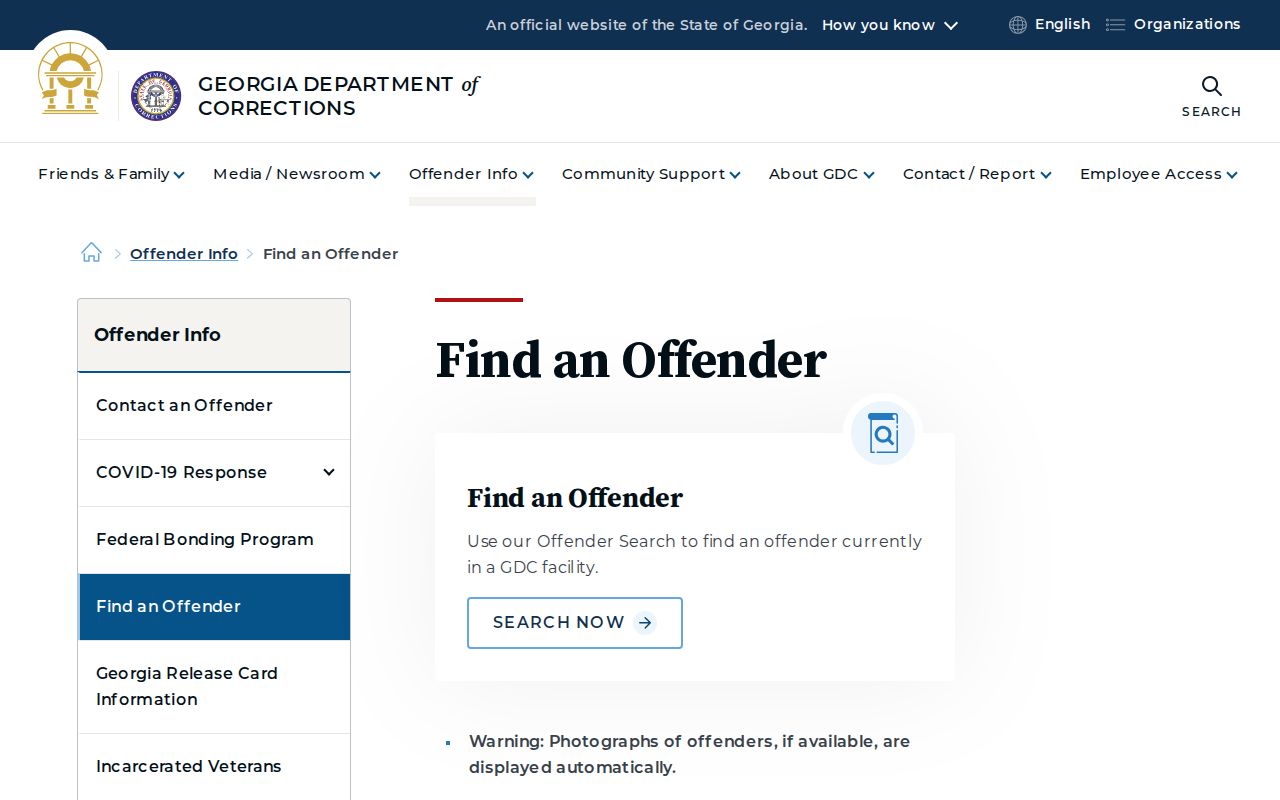
The state result may show status, most recent institution, offense or case data, a release date, and a photo when available. GDC warns that online data may be incomplete and directs written verification to Inmate Records and Information, P.O. Box 1529, Forsyth, GA 31029.
Do not confuse “Most Recent Institution” with “Conviction County.” The first field connects the person to the last GDC facility in the record. The second identifies where the sentence began. Someone convicted in Clayton County may serve elsewhere, while a person held at Clayton County CI may have been convicted in another county. Open the individual result and compare identifiers before relying on either filter.
Release-date terms also need care. GDC defines Maximum Release Date, or MRD, as the max-out date when the judge's sentence will be completely served. A Tentative Parole Month comes from the Parole Board and marks a conditional review or planned month, not a promise of physical release. An inactive status may follow release, sentence completion, or another change. Verify the final event with the state, parole, and court records that apply.
Clayton County Recent Jail Releases
Clayton County does not advertise a separate 24-hour or 72-hour release-only feed in the official material reviewed. The sheriff documents booking-date searches for the past 48 hours, 14 days, and 31 days. Those ranges can contain people still held as well as people already discharged. The name search is different: it shows active inmates only.
A release believed to be within one day should start with the 48-hour booking range. For an event 49 to 72 hours ago, the 14-day range is the closest official choice. Confirm the discharge field or authority because a booking date is not a release date. The electronic docket is updated regularly, but the sheriff does not publish an exact refresh interval. Older details remain available through the statutory jail record and printed docket even when a convenient online window has passed.
Clayton County promotes the Click Clayton mobile app, but the reviewed official text does not confirm a dedicated sheriff release feed in that app. Use the sheriff docket and records channels unless an official app screen proves otherwise.
Clayton County Post-Release Supervision
A prison release to parole is a State Board decision followed by field supervision through the Georgia Department of Community Supervision. Felony probation generally comes from a court sentence and is also supervised by DCS. These are not the same. Parole follows part of a prison sentence; probation is imposed by a judge and can begin without a prison commitment or after a split sentence.
Before release, use the Board's TPM lookup explanation and lookup tool. A Tentative Parole Month is conditional, not a final exit date. After release, the Parolee Search may show a parole begin date, end date, office, office number, and primary offense. Probation confirmation may require the court order and local DCS office.
Clayton Release Supervision in Morrow
The DCS Morrow field office serves Clayton County and the Clayton Judicial Circuit. It gives a local contact point for a released state offender or felony probationer. The office is at 1335 Citizens Parkway, Suite A, Morrow, GA 30260, and lists Monday through Friday hours from 8:00 a.m. to 4:30 p.m.
DCS can explain its supervision contact process, but some individual details are not public. Use the parolee database for releasable parole status, the sentencing court for a probation order, and DCS for office routing. The fuller Clayton County Probation & Parole page distinguishes these sources and defines discharge from supervision.
Clayton Release Alerts and Federal Checks
Georgia VINE offers a custody-status check and notification layer for participating agencies. Search one person, compare agency and identity details, open the matching record, and register for an offered phone, text, email, or app notice. A released result may show that the person left the reporting agency. It may not explain the court outcome, supervision, or transfer. Confirm the event with the sheriff, GDC, court, or Parole Board record.
A sentenced federal prisoner belongs in the BOP inmate locator, which covers federal inmates from 1982 onward and may show a release date or “Not in BOP custody.” A federal pretrial detainee may require the federal court docket, U.S. Marshals contact, or the holding facility. Immigration custody belongs in the ICE Online Detainee Locator System. None of those federal routes proves a Clayton County jail discharge reason.
VINE is also narrower than a court or records request. A notification can tell a registered user that the reporting custody status changed, but it may arrive after agency data is transmitted and processed. It cannot show every federal or immigration move, and a no-result response does not prove release. Keep the agency's contact details, then use the source that owns the underlying record when documentary proof is needed.
Clayton Transfer Is Not Release
Clayton County has an unusual overlap of local, state, and federal facilities. The sheriff posts “Immigration Responses/Requests” totals, while Robert A. Deyton Detention Facility in Lovejoy is listed by GEO Group as serving the U.S. Marshals Service and has ICE-related public material. A person can leave the Clayton County jail under a transfer and remain detained nearby.
Read the county discharge authority first. If it names another agency, follow that agency's locator. ICE ODLS is the immigration route. BOP is appropriate after federal sentencing, but it may not cover a short U.S. Marshals pretrial movement. Federal court and facility channels may then be necessary. “Released from Clayton County custody” and “released to the community” are different claims.
Where Clayton Release Status Appears
Choose the source by custody type and time. Live rosters answer present-custody questions; release records explain a completed custody event. State and federal systems cover their own populations.
| Source | Still in custody | After release |
|---|---|---|
| Clayton sheriff docket | Active name search | Booking-date windows, statutory discharge record, printed docket |
| Clayton courts | Open case and custody orders | Bond, disposition, sentence, dismissal, or transfer event |
| GDC offender query | Active offender scope and facility | Inactive scope, recent-release filter, release and sentence fields |
| Parole Board / DCS | TPM before a possible parole | Parole record or supervision office after release |
| BOP / ICE | Federal or immigration custody | Release or no-longer-in-custody status when available |
Is absence from active jail name search proof of release? No. Clayton County says that path is active-only, but absence may also result from spelling, data lag, transfer, or a different custody system. Verify the discharge day and authority.
Clayton County Release Facilities
Clayton County's facility map extends beyond the sheriff's jail. Each link below uses the release route that fits the institution. State facilities rely on GDC and parole records. Deyton requires federal or immigration channels. Municipal holding may leave only a citation, court entry, or later county jail booking.
- Clayton County Jail / Clayton County Detention Center: use the sheriff docket, discharge record, and issuing court.
- Clayton County Correctional Institution / Clayton County Prison: state offenders require GDC, Parole Board, and DCS checks.
- Clayton Transitional Center: residents remain in the GDC system until release, parole, or discharge.
- Robert A. Deyton Detention Facility: use federal court, USMS, BOP, or ICE channels.
- Municipal Police Holding in Clayton County: check for county transfer, citation, and the proper local court record.
The two GDC-linked Clayton facilities make a one-roster search especially unreliable. A person can be physically in Clayton County yet have no active Clayton County sheriff booking. Start with the holding agency, then confirm where custody ended and whether supervision began.
Municipal police holding is the least likely to create a durable county release listing. A cited person may leave without ever entering the Clayton County jail. In that case, a citation, warrant return, municipal case, State Court matter, or Magistrate Court event may be the lasting trail. If the local police transferred the person to the jail, the sheriff booking begins a separate record and the county search becomes relevant.
Clayton Transitional Center is also not a post-release residence outside custody. Its residents remain GDC offenders while in the transition setting. Their final parole, discharge, or move belongs in the GDC and Parole Board systems. Clayton County Correctional Institution similarly houses state offenders even though the county operates it. These distinctions explain why the physical address alone cannot select the right lookup.