
Clayton Projected Release Date Types
Four terms must stay separate. A Clayton County jail discharge date is the day a person actually leaves the jail under bond, time served, a court order, transfer, or another authority. A GDC Maximum Release Date, abbreviated MRD, is the max-out date when the judge's state sentence will be fully served. A Tentative Parole Month, or TPM, is the month the Parole Board plans to complete final review and possibly set parole release. The actual release date is when custody ends or parole begins.
A pretrial detainee does not have a sentence-based projected release date. The case may have a bond amount or hearing date, but release still depends on bond processing, the court, holds, and administrative checks. A sentenced person may have a calculable date, yet credits, Board action, or another warrant can change it. The label beside the date is therefore as important as the date itself.
| Date or status | What it means | Where to verify |
|---|---|---|
| County discharge day | Actual exit or transfer from Clayton County Jail | Sheriff inmate record and release order |
| MRD | Maximum date the state sentence is fully served | GDC offender record and Inmate Records |
| TPM | Tentative month for final parole review | State Board TPM lookup |
| Parole release date | Actual transition from prison to parole | Board, GDC, and parolee records |
Find Clayton GDC Release Dates
State-prison dates belong in the Georgia Department of Corrections offender query. The form can search active, inactive, or both active and inactive records. It also includes “Max Prison Term Ending Next 15 Days” and “Released In The Past 15 Days” sentence-status choices. Those are statewide GDC filters, not Clayton County jail release feeds. Most Recent Institution includes Clayton County CI, Clayton County Jail, and Clayton TC, while Conviction County can be set to Clayton County.
Most Recent Institution and Conviction County answer different questions. The first concerns where GDC last shows the person. The second concerns where the sentence arose. A person convicted in Clayton County may be housed elsewhere, and a state offender housed at Clayton County Correctional Institution may have been convicted in another county. Search broadly before narrowing the result.
- Open the GDC query and accept its accuracy disclaimer.
- Use the GDC ID or case number when available. These are more precise than a name alone.
- For a name search, enter the name and only add age, race, or gender filters when known.
- Select both active and inactive records when the expected status is uncertain.
- Use the sentence-status filter for a near MRD or recent GDC release when it fits the question.
- Open the record and distinguish MRD, status, institution, case, and any parole information.
- Verify a critical date with GDC Inmate Records and the court or Parole Board record.
The GDC terminology page is the official source for MRD and TPM definitions. Review that source before using its captured reference.
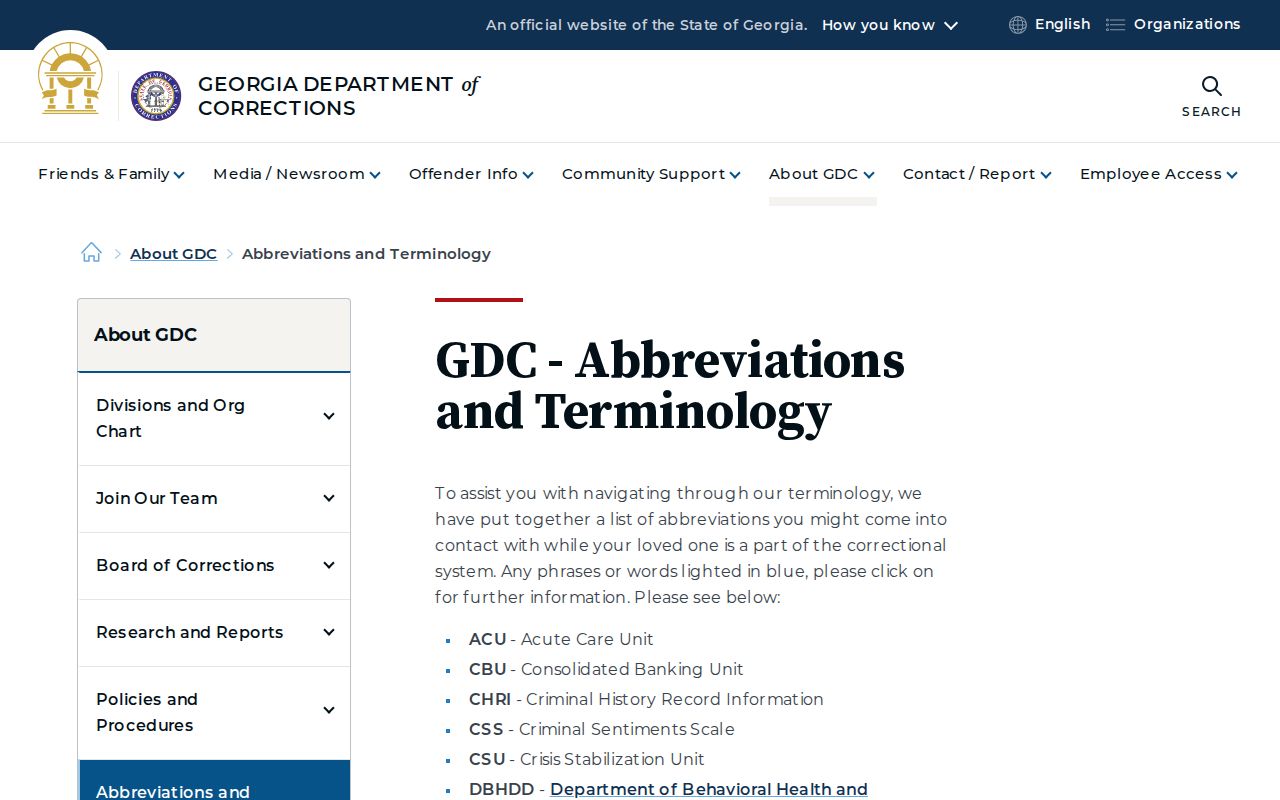
The screenshot supports the key reading rule: maximum release and tentative parole are distinct terms with distinct legal effects. GDC warns that online information may be incomplete and directs verification requests to Inmate Records and Information.
Clayton Jail Projected Release Checks
Clayton County Jail does not calculate dates in the same public system as GDC. Under O.C.G.A. 42-4-7, the sheriff's inmate record includes the commitment date, day of discharge, order under which the person was discharged, and the court that issued the order. Those fields explain an actual county release. Before release, the date may depend on the court, bond, a local sentence calculation, or another agency hold rather than a single projected-date field.
The sheriff's online inmate search covers active names only. Booking-date searches cover the past 48 hours, 14 days, or 31 days. A missing name is not proof that a projected date arrived. Search the booking window, then use the court docket or request the statutory inmate record. The Classification Section correction line is 770-477-4441, Monday through Friday, 8:00 a.m. to 5:00 p.m., for inaccurate or stale electronic docket information.
Clayton County court records may show the trigger for release: bond, dismissal, time served, sentence, probation, or a transfer order. Superior Court handles felony cases, State Court handles misdemeanors and traffic matters, and Magistrate Court handles preliminary hearings, warrants, and some misdemeanor matters. The correct court depends on the case. A pretrial hearing date should never be presented as a release date. The broader Clayton County released inmates record path explains how to match the order to the jail discharge.
Clayton Release Credits and PIC
Georgia's Performance Incentive Credit program is the clearest public earned-time mechanism for eligible state offenders. GDC says a person can build up to 12 points. Each point may equal one month of credit, with a possible reduction of one to 12 months from either the TPM or MRD. The three public paths are case-plan progress, education or vocational improvement, and detail or work assignment.
PIC is not a promise that every inmate receives early release. Eligibility, the award of points, and whether credit affects TPM or MRD depend on GDC and Board rules. Institutional conduct and completion of required work matter. The public GDC PIC page should be read as a program description, not as a calculator for one person.
The captured source keeps the earned-credit explanation tied to GDC's own language.
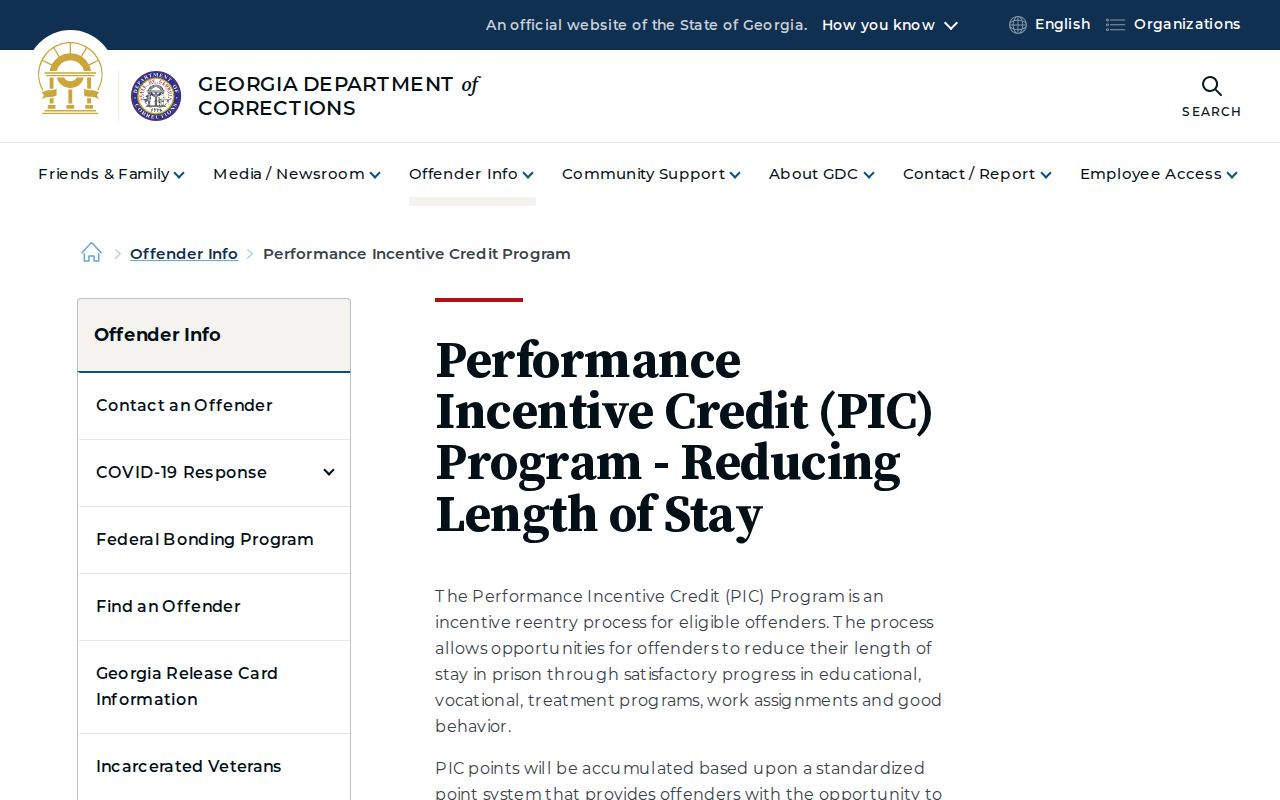
The PIC page shows why sentence credit can move a projected date while still leaving final release subject to the official record.
- MRD
- Maximum Release Date, when the imposed state sentence reaches its max-out point.
- TPM
- Tentative Parole Month, a conditional Board planning month rather than a final grant.
- PIC
- Performance Incentive Credit, points that may reduce an eligible offender's TPM or MRD.
- Detainer
- A request or notice that another authority may seek custody, which can block community release.
Clayton Parole Dates Are Conditional
The State Board says most parole-eligible inmates are statutorily eligible after one-third of the prison sentence, but eligibility is only the right to be considered. It is not a right to leave prison on that date. Serious violent felonies, life sentences, life without parole, and recidivist restrictions can alter or eliminate the ordinary path. Georgia should not be reduced to a blanket claim that every offender serves one fixed percentage.
Life-sentence rules also depend on offense and date. The Board describes seven-year eligibility for certain pre-1995 serious violent felony life cases, a fourteen-year rule following 1995 changes, and potential thirty-year eligibility for covered offenses on or after July 1, 2006. These are eligibility points, not guaranteed Clayton County release dates.
A TPM may be conditioned on good conduct, treatment, or other requirements. Misconduct can postpone or cancel it. Strong conduct and rehabilitative work may advance a TPM by a few months under Board policy and PIC consideration. The official parole eligibility guidance provides the correct statewide frame.
Note: A parole meeting notice is not an individual hearing calendar, and public monthly Board meetings do not decide offender cases.
Why Clayton Release Dates Change
Projected dates move when the facts or legal authority behind them change. County jail processing can wait on bond verification, warrants, holds, or court paperwork. State dates can move because of credit, discipline, parole action, or a sentence correction. Federal and immigration custody use separate systems entirely. A date should be rechecked whenever the person changes facilities or custody type.
| Factor | Possible effect | Record to check |
|---|---|---|
| Jail or sentence credit | May reduce time left if officially applied | Court, jail calculation, or GDC record |
| PIC award | May reduce eligible TPM or MRD | GDC and Board records |
| Disciplinary event | May delay or cancel a tentative parole point | GDC and Parole Board |
| Detainer or warrant | May cause transfer or continued custody | Holding agency and issuing authority |
| Court order | May alter sentence, bond, or release authority | Clayton or sentencing court docket |
| Parole decision | May grant, deny, postpone, or withdraw release | State Board record |
| Transfer | Changes the agency controlling the next date | County, GDC, BOP, USMS, or ICE record |
A transfer out of Clayton County Jail can be recorded as a discharge from county custody even when the person remains confined elsewhere. Robert A. Deyton Detention Facility, BOP, and ICE custody are not covered by the sheriff roster or GDC date definitions. For a federal sentence, use the BOP locator. For immigration detention, use ICE ODLS.
Clayton Release Dates Use Two Systems
Clayton County has both a county jail and GDC-linked facilities, so local release-date questions often cross systems. The county jail record is built around commitment, discharge, and the court's release order under O.C.G.A. 42-4-7. Clayton County Correctional Institution and Clayton Transitional Center belong to the state sentence framework, where MRD, TPM, Board decisions, and PIC can all matter.
This is more than a difference in website design. A county release might be caused by bond or a court order. A GDC release might be max-out, parole, or another state disposition. Searching only the county docket for someone at Clayton Transitional Center will miss the controlling state record. Searching only GDC for a pretrial jail detainee can create the opposite mistake.
The correct order is agency, legal status, date label, then verification. That four-part check keeps a projected release from being mistaken for an actual exit.
Confirm Clayton Actual Release Dates
Near the expected date, repeat the agency search. A GDC record may move from active to inactive, while the county jail docket may record the discharge day and authority. A parolee record can show the start of parole and the assigned office. Court entries may explain bond, dismissal, sentence completion, probation, or transfer. No one result answers every part of the release.
Georgia VINE can provide a custody-change alert if the relevant agency participates. The Clayton County VINELink inmate search explains how to register and how to read a released result. VINE is an alert layer, not a certified release order. GDC directs formal verification to Inmate Records and Information at P.O. Box 1529, Forsyth, GA 31029.
For county records, the Clayton open records portal can be used to request the statutory inmate record. Ask for the commitment and discharge fields and the order that authorized discharge. That record turns an expected date into documented release evidence.