
Clayton Release Mugshots and Records
A booking photograph is made during arrest processing. It identifies the person associated with a booking, but it does not show a conviction, a case outcome, or current custody by itself. Clayton County's sheriff docket is the first official local source for the booking record. The researched sheriff text does not clearly promise that a photo appears in every public docket result, and the inmate-record fields required by Georgia law do not include a photograph.
Release does not automatically delete an image. The jail's active name search may stop returning the person because Clayton County says name search is limited to active inmates. The underlying statutory inmate record still includes identifying details, the commitment date, discharge day, discharge order, and issuing court. A photo found elsewhere should be checked against those facts and the Clayton County court case inquiry.
Where Clayton Release Mugshots Appear
Photo availability changes by custody type. A county booking photo belongs to the arresting or booking agency. A GDC photo belongs to a state offender record. A news image may have been published for a specific event. VINELink can help identify a matching custody record but should not be assumed to display a photo for every participating agency. No official source guarantees that every released person has a public image online.
| Channel | Has photo? | How to access |
|---|---|---|
| Clayton sheriff docket | Not confirmed in the reviewed official text | Search the official booking-date windows and inspect the live result |
| Clayton open records request | Possible if lawfully releasable | Request the booking photo through the county portal under Georgia law |
| GDC offender query | Yes, when available | Choose photo results and open the individual state offender record |
| VINELink | Varies by agency record | Use Georgia VINE to match custody status, then verify with the source agency |
| Official news or press release | Sometimes | Search the agency or news archive for the specific case |
| Non-official mirror | Sometimes | Treat only as a lead, then return to official records |
For Clayton County Jail, begin with the sheriff. For Clayton County Correctional Institution or Clayton Transitional Center, begin with GDC. Robert A. Deyton is a federal contract facility, so a county booking-photo request may not reach its records. The agency that made or controls the image is the correct destination.
Clayton Jail Mugshot Search Limits
The Clayton County inmate search doorway leads to the sheriff's jail docket. The sheriff documents booking-date searches for the past 48 hours, 14 days, or 31 days, plus name search for active inmates only. A recently released person may disappear from name search. Use the booking-date range that covers the original booking, then read any available record detail rather than assuming the search is a release-photo gallery.
The docket is updated regularly, but the sheriff does not promise a precise update time. The official page also warns that the data changes rapidly and does not imply a conviction. If an electronic entry appears inaccurate or stale, the Classification Section accepts correction questions at 770-477-4441, Monday through Friday, 8:00 a.m. to 5:00 p.m. That line is for docket issues, not a promise that staff will release a restricted photograph.
When a docket image is visible, match it with the booking date, charge or process, court, and discharge fields. When no image appears, the absence may reflect page design, a records policy, a technical limit, or the age of the booking. It does not prove that no booking photo was taken.
Note: The sheriff maintains a printed jail docket for public viewing, but Georgia's required inmate-record fields do not include a photograph.
Clayton Mugshots Are Not App-Only
Clayton County's official pages promote the Click Clayton mobile app. The reviewed sheriff text did not confirm a sheriff-specific inmate app, an app-only recent-release feed, or a mugshot feature within Click Clayton. That is a useful limit. Some counties publish jail images through a vendor app, but no such claim should be made here without direct official proof.
Use the county app only for features it actually presents. For a local booking photo, return to the official sheriff docket or the open records process. The Clayton jail releases in 24 hours coverage explains why the nearest official recent search is a 48-hour booking-date window, not a photo-based list of people released that day.
This distinction prevents two errors. First, county mobile branding does not prove that jail records are inside the app. Second, a booking-date result is not necessarily a released-person result. Confirm the discharge day and authority through the inmate record or court order.
Request Clayton County Booking Photos
When the live docket does not display a photo, use the Clayton County open records portal. Request the specific, releasable booking photograph and enough record detail to identify the booking. Georgia's Open Records Act favors access to public records, but specific exceptions and the booking-photo statute still control what the agency can provide.
- Identify the arresting or booking agency. Use Clayton County only when it controls the requested photo.
- Provide the person's full name and the known booking or arrest date. Add a booking number or case number if available.
- Ask for the releasable booking photograph tied to that single booking, not a broad image collection.
- State the intended lawful use accurately and answer any compliance questions required by O.C.G.A. 35-1-19.
- Ask for an estimate before production if search, review, redaction, or copy costs may apply.
- Read the agency response for a release, condition, partial production, or cited legal basis for withholding.
O.C.G.A. 50-18-71 governs response timing, costs, and production mechanics. The law requires a prompt response, but it does not guarantee that every requested image is releasable. A request can be narrowed if the first description is too broad. Keep the agency's written response with the photo so its source and limits remain clear.
Clayton GDC Release Mugshots Differ
The GDC offender query is the strongest official photo path for a person who was in state custody. The query warns that photos are displayed automatically when available. Search results can be shown with photos, and an individual offender record displays a photo when GDC has one. Search both active and inactive records when the person is believed released.
GDC offers name and description fields, GDC ID and case-number search, most recent institution, conviction county, and sentence-status filters. For a Clayton link, Most Recent Institution can include Clayton County CI, Clayton County Jail, or Clayton TC. Conviction County can also be Clayton County, but it does not mean the person was housed there. The two fields should never be swapped.
Open the official offender query before reviewing the captured image.
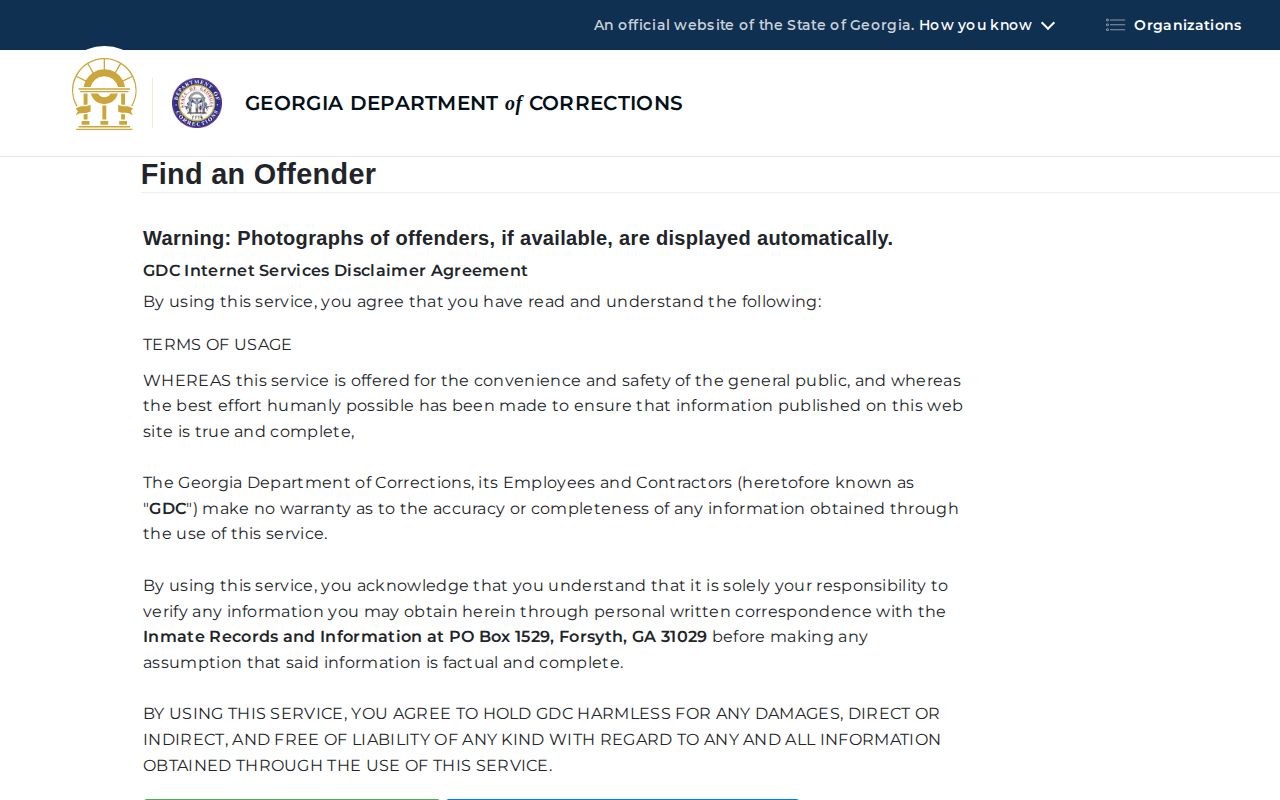
The screenshot documents GDC's photo language and supports a state-offender photo search, not a claim that every Clayton County arrest photo is available there. A GDC offender photo is not the same item as a sheriff booking photo. It may reflect a later point in the custody history, so verify the release date, inactive status, most recent institution, and case data alongside the image.
Georgia Law Limits Clayton Mugshots
O.C.G.A. 35-1-19 creates a specific booking-photo restriction. An arresting law-enforcement agency cannot provide a booking photograph when it may be placed in a publication or on a website and removal or deletion would require payment or other consideration. A requester may have to make compliance statements, and an agency may condition or deny release under the statute.
The rule does not mean that every mugshot is sealed. It also does not erase a GDC photo or a lawfully published news image. It targets a particular pay-for-removal practice and changes how an arresting agency handles a photo request. The Georgia Attorney General consumer page on mugshot websites explains the state concern and relevant media context.
Review that official state source before using the captured page.
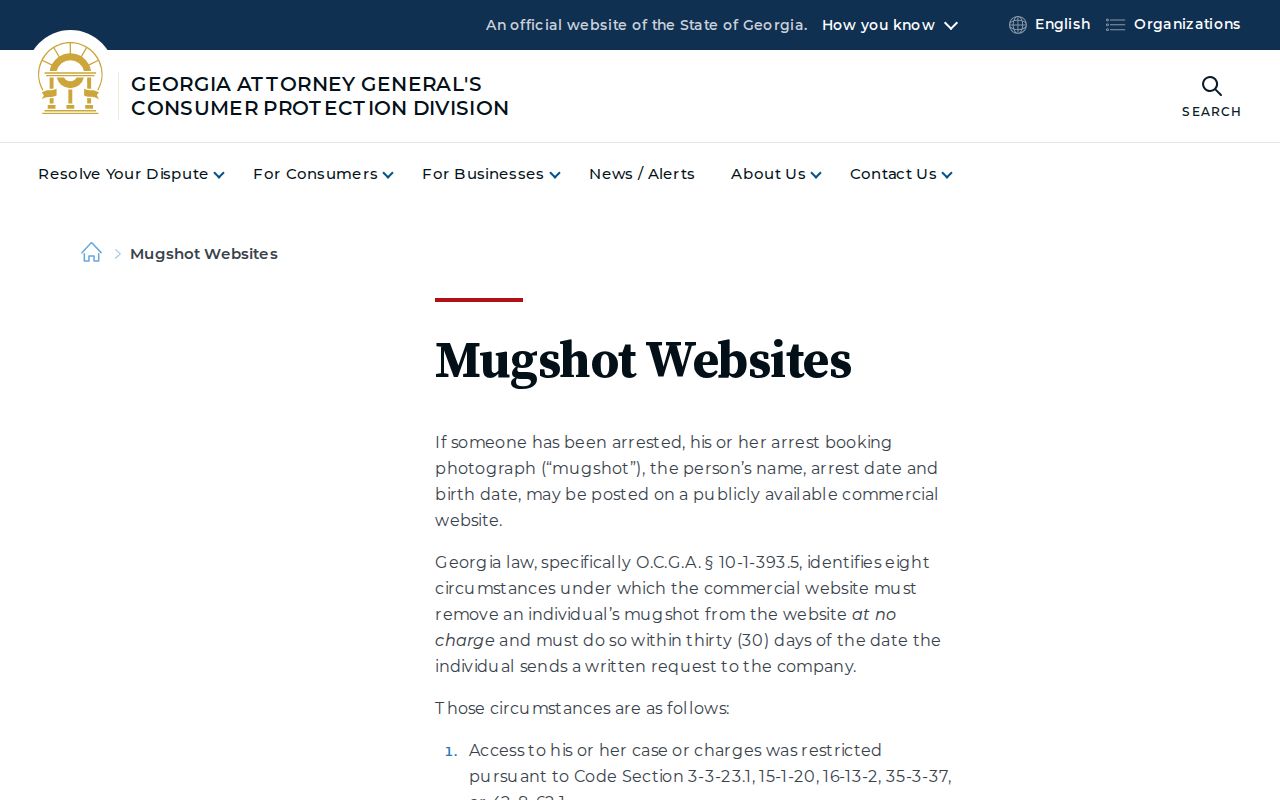
The state page gives the legal frame for a Clayton booking-photo request and reinforces the value of official verification.
Clayton Mugshots in News and Mirrors
An official agency release or local news report may carry an arrest image when a case was newsworthy. That image can help connect a name with an event, but it may predate bond, dismissal, sentence, transfer, or release. Check the Clayton County court docket and the sheriff discharge record for what happened later. A news caption is not a live custody status.
Non-official mirrors can retain an old image after the source record changes. They may omit a disposition, show the wrong person with a similar name, or preserve a stale caption. No commercial mugshot publisher or data broker is linked here. Treat any non-official copy only as a lead, and return to the sheriff, GDC, court, or records office for proof.
Georgia's statutory media exception and its restrictions on pay-for-removal activity are separate concepts. A lawfully published news image is not automatically governed the same way as a new request to an arresting agency. Legal questions about a specific publication or removal demand require advice from a qualified attorney, not an assumption based on the image alone.
Note: An image without a matching booking number, case, agency, and date should not be treated as a confirmed Clayton County record.
Clayton Mugshots After Record Restriction
Georgia often uses the term record restriction rather than expungement. A restricted, sealed, juvenile, or otherwise protected case can reduce public access, but it does not support a promise that every copy of a booking photo disappears. Each agency applies the lawful restriction to the records it controls. A court order should be directed to the clerk, sheriff, GDC, or other source identified in the order.
Start with the court disposition. Confirm that the order is final and identify its scope. Then ask the agency that publishes or controls the official image how the order applies to its record. Preserve the response. If a non-official publisher still shows an image, do not pay a removal service based only on a demand. Georgia's Attorney General page describes the state's protections and complaint context.
The most accurate Clayton County photo record is one kept with its source, booking date, case number, disposition, and release confirmation. That full frame respects the person shown and prevents an arrest-stage image from being mistaken for the end of the case.