
Clayton Parole and Probation Compared
Parole and probation both allow a person to live in the community under rules, but they begin in different ways. The State Board of Pardons and Paroles decides whether an eligible state inmate will be paroled. The Georgia Department of Community Supervision, known as DCS, then handles field supervision. Probation comes from the sentencing court. DCS says adult felony probation may be a probated sentence or part of a split sentence, which combines prison time with probation afterward. A Clayton County jail release can therefore lead to probation without any parole decision.
The distinction controls where to verify the record. A parolee is a person released from state prison before the full sentence ends, subject to Board terms. A probationer is serving a court sentence in the community. Discharge means the supervision term has formally ended. Someone may also leave custody with no supervision at all. The county jail docket cannot settle those questions by itself because it records commitment and discharge, not the full life of a later supervision term.
| Point | Parole | Probation |
|---|---|---|
| Who creates it | State Board of Pardons and Paroles | Sentencing court |
| What comes before | A state prison sentence | Jail, prison, or a direct community sentence |
| Best public check | Parolee search after release | Clayton County court sentence or disposition |
| Field supervision | Georgia DCS | Georgia DCS for adult felony probation |
| How it ends | Parole expiration or formal discharge | Court-ordered term completion or discharge |
- TPM
- Tentative Parole Month, a planned Board review month rather than a promised release date.
- Split sentence
- A sentence with confinement followed by probation.
- Discharge
- The formal end of custody or supervision under the controlling record.
- Absconder
- A supervised person alleged to have stopped reporting or left supervision without approval.
Verify Clayton Post-Release Supervision
Start with the custody history, not a guess. If the person left Clayton County Jail after bond, time served, or a probation sentence, the Clayton County court docket may be the only clear source for probation. If the person left Clayton County Correctional Institution, Clayton Transitional Center, or another GDC prison, use the Board and GDC paths. The Board's public tools separate an inmate who is still being considered from a person who is already on parole.
- Identify whether the last custody was the county jail or a GDC facility. The Clayton County sheriff page documents the local jail path.
- For a person still in prison, use the Board's TPM lookup explanation and lookup tool. A TPM is preliminary, not proof of release.
- After a claimed parole release, use the official parolee search. Match the parole dates, office, and primary offense with care.
- For felony probation, search the Clayton County court disposition. Superior Court handles felony cases and can show a probated or split sentence.
- Contact the DCS Morrow field office when the public result points to Clayton Circuit supervision or when office details need confirmation.
- Use the release record on Clayton County released inmates to confirm when county custody ended, then keep that date separate from supervision discharge.
Public probation detail can be thinner than public parole detail. That is expected. The court's sentence remains the key starting point, and DCS is the proper state field agency for adult felony probation. Lower-level cases may involve other arrangements set by the sentencing court, so the court record controls rather than a broad assumption about who supervises the person.
Clayton Probation Office in Morrow
Clayton County has a direct local supervision contact. The DCS Morrow field office serves Clayton and the Clayton Circuit. It is the useful local follow-up when a parolee search lists a Clayton-area office or a Superior Court disposition imposes adult felony probation. The office is not the county jail and does not replace a court clerk. Its role is community supervision after the custody or sentencing event.
Georgia DCS Morrow Field Office
1335 Citizens Parkway, Suite A
Morrow, GA 30260
Monday-Friday, 8:00 a.m.-4:30 p.m.
Serves Clayton and Clayton Circuit
The DCS felony supervision page explains the agency's statewide role. When calling or visiting, have the person's full legal name, date of birth if lawfully known, court case number, GDC ID if relevant, and the office shown in the parole result. Staff may limit what can be disclosed. The official office page gives the best view of this local contact and shows why Clayton County parole and probation verification should not stop at an Atlanta headquarters listing.
View the official DCS Morrow office source before using the location details.
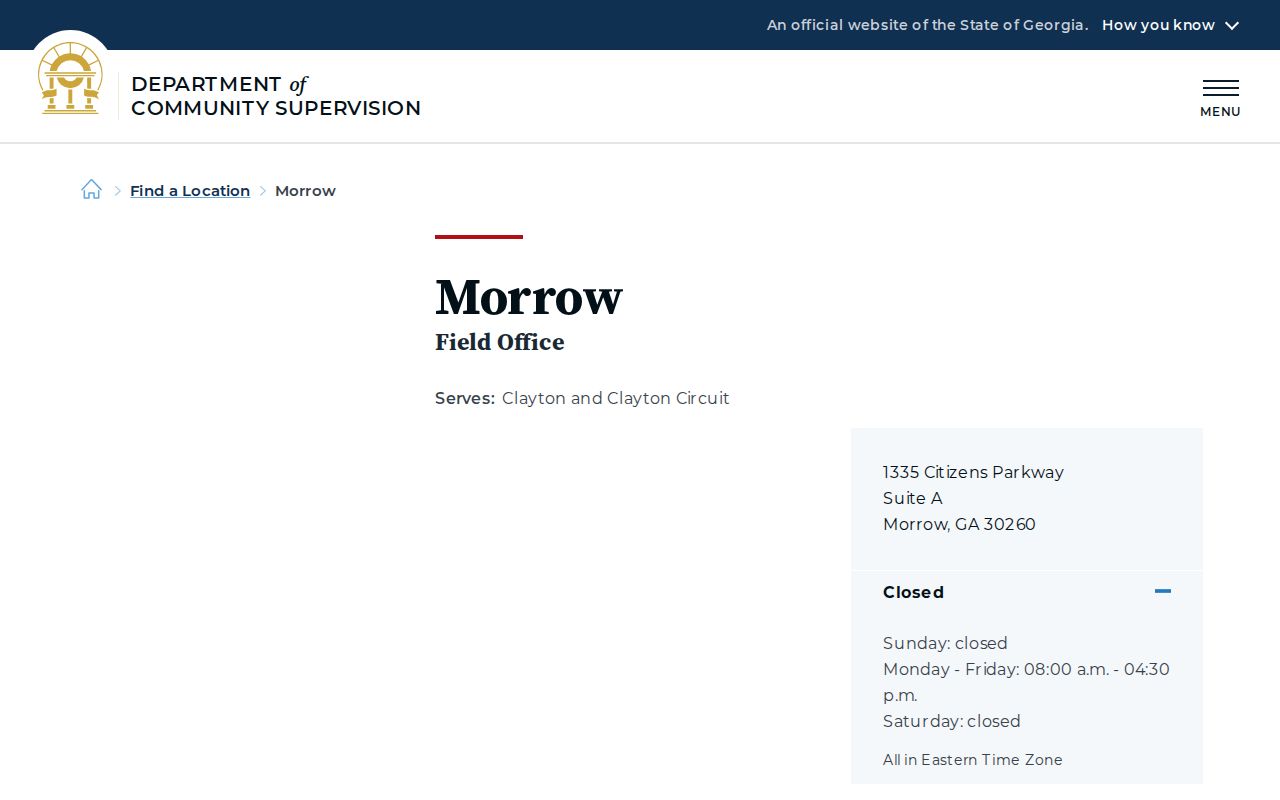
The captured office page ties Clayton Circuit supervision to a real local field office rather than to the sheriff's custody roster.
Clayton Parole Decisions and Meetings
Georgia's public monthly Parole Board meetings are business meetings. They are not individual offender hearings, and the Board's meeting notices say offender cases are not discussed or decided there. Individual parole consideration is a file-based Board process. Someone trying to learn the outcome of one Clayton County offender's case should use the TPM lookup before release and the parolee database after release, not assume a public meeting calendar contains a personal hearing.
The Board may set a TPM, set a reconsideration date, deny parole, grant parole after final review, postpone or cancel a TPM, or withdraw a grant before it takes effect. A majority affirmative vote is required for clemency decisions. The Board press-release page is useful for notices about monthly public meetings, policy, cancellations, and agendas, but it is not a case-results list.
Eligibility also does not guarantee release. The Board says most parole-eligible inmates become eligible after one-third of the sentence, yet serious violent felonies, life sentences, life without parole, and recidivist rules create major exceptions. The controlling date and eligibility record must be read for the individual sentence.
Clayton Supervision Violations and Warrants
An absconder status is not a synonym for release. It means the supervising authority alleges that a person stopped reporting or otherwise left supervision without approval. A violation can lead to a warrant, a preliminary hearing, revocation proceedings, added conditions, or a return to custody. Georgia Parole Board rules in Chapter 475-3 address parole violation and revocation processes. DCS and the supervising court handle the record appropriate to the case.
No stable official Clayton County absconder list was found in the research. Do not infer a warrant from a failed web search. For parole, start with the Board record and the listed parole office. For felony probation, use the sentencing court and DCS. A local arrest warrant may also appear through the court process. Georgia VINE can alert users to a custody change when a participating agency supplies data, but it does not certify whether a supervision warrant is active.
Conditions vary by sentence and Board order. Common high-level duties may involve reporting, following travel limits, paying court-ordered amounts, completing programs, and obeying the law, but only the actual order states the terms for one person. A public summary never overrides that order.
Note: A transfer from county custody to another agency is not the same event as release to community supervision.
Clayton Parole Reentry Starts Locally
Clayton County's Morrow office is the distinctive local link between a state release and day-to-day supervision. A parole decision comes from the State Board, while GDC records the prison history and DCS manages field contact. That division matters when a family member sees an inactive GDC record but cannot tell whether the person is free of supervision. Inactive custody and discharged supervision are not the same status.
For a felony probationer, the path runs from the Clayton Superior Court sentence to DCS. For a parolee, it runs from the Board decision and prison release to the parolee database and assigned DCS office. Keeping those chains separate prevents a common error: asking the Sheriff's Office to interpret a state parole term after the county jail's role has ended.
The Board homepage gives a useful visual entry point to inmate and parolee records. Open the State Board of Pardons and Paroles source before reviewing the captured page.
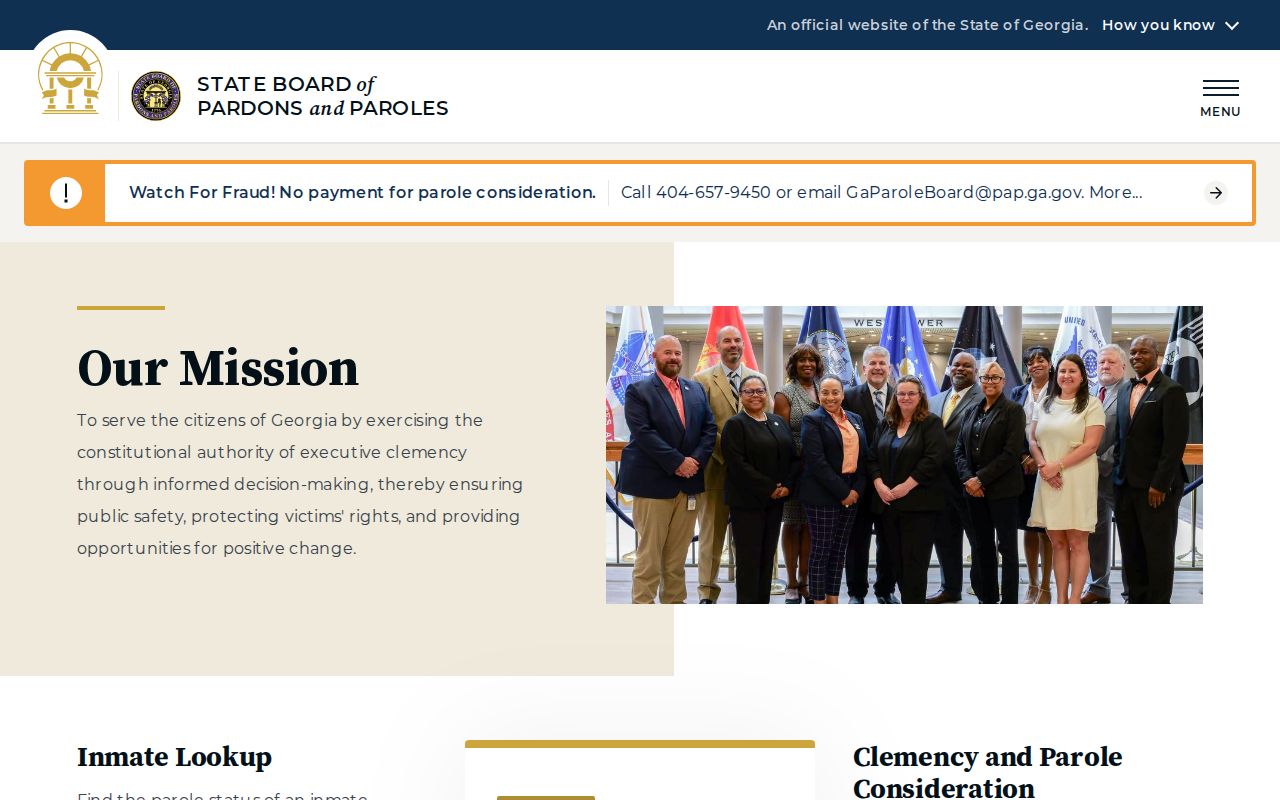
The two lookup paths shown there reflect the key timing difference: inmate review before release and parolee status after release.
Clayton Parole and Probation Discharge
Supervision ends through a formal record, not merely because a person has not been seen at an office. A parole record may show a parole end date, while probation completion follows the sentence and any court action. Early termination, revocation, tolling, or another order can alter the expected end. Tolling means that the running of a term is paused under applicable law or order. The supervising agency and court record provide the reliable answer.
After parole discharge, the GDC and Board records may still preserve the earlier custody and supervision history. After probation ends, the criminal docket may still show the sentence and final disposition unless access is lawfully restricted. Record restriction is Georgia's common term for limiting public criminal-history access in qualifying circumstances. It should not be confused with a claim that every jail, court, or state record vanishes.
For a complete Clayton County check, match three dates when they exist: release from custody, beginning of supervision, and discharge from supervision. Each comes from a different event. That sequence provides a clearer answer than any one roster search.